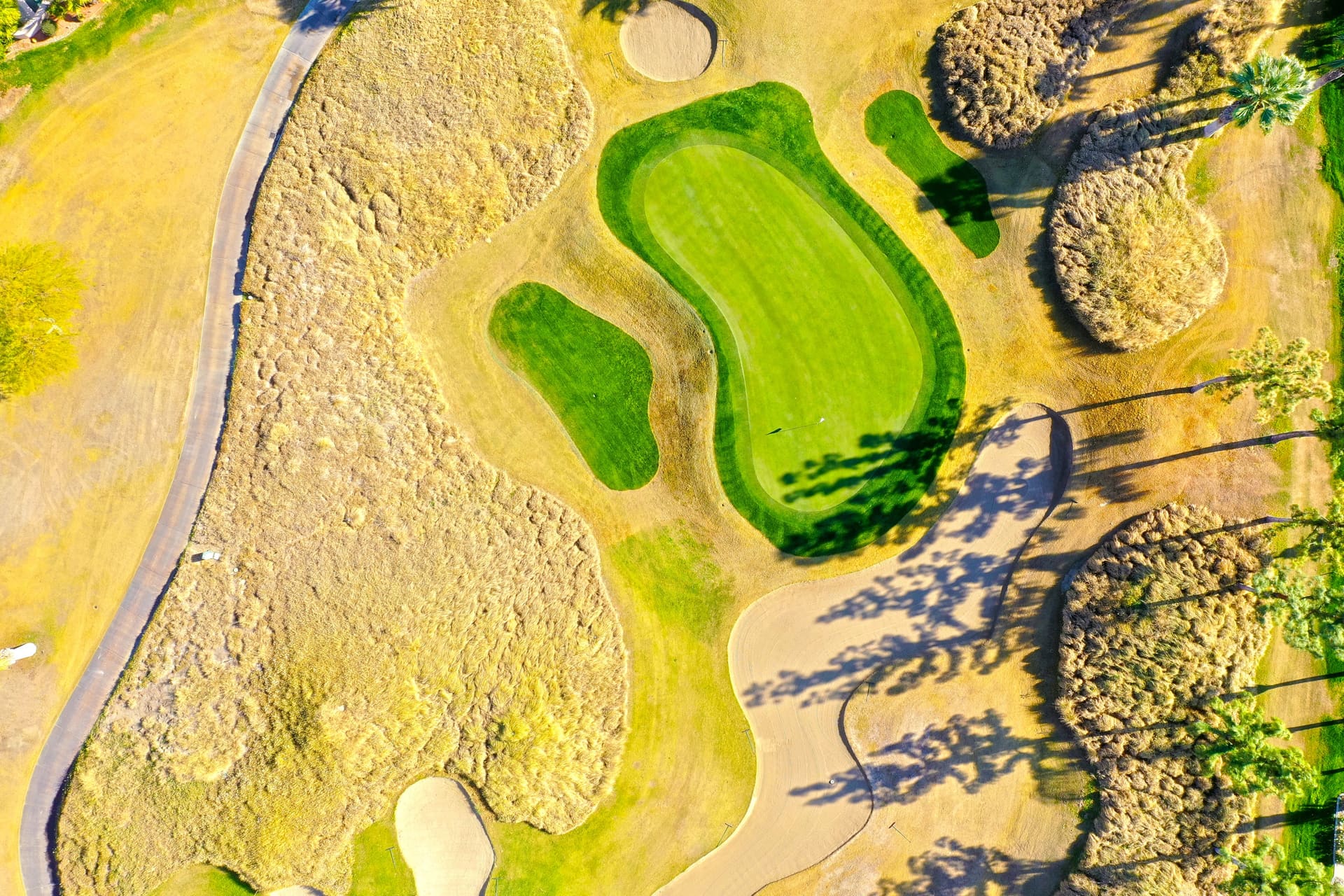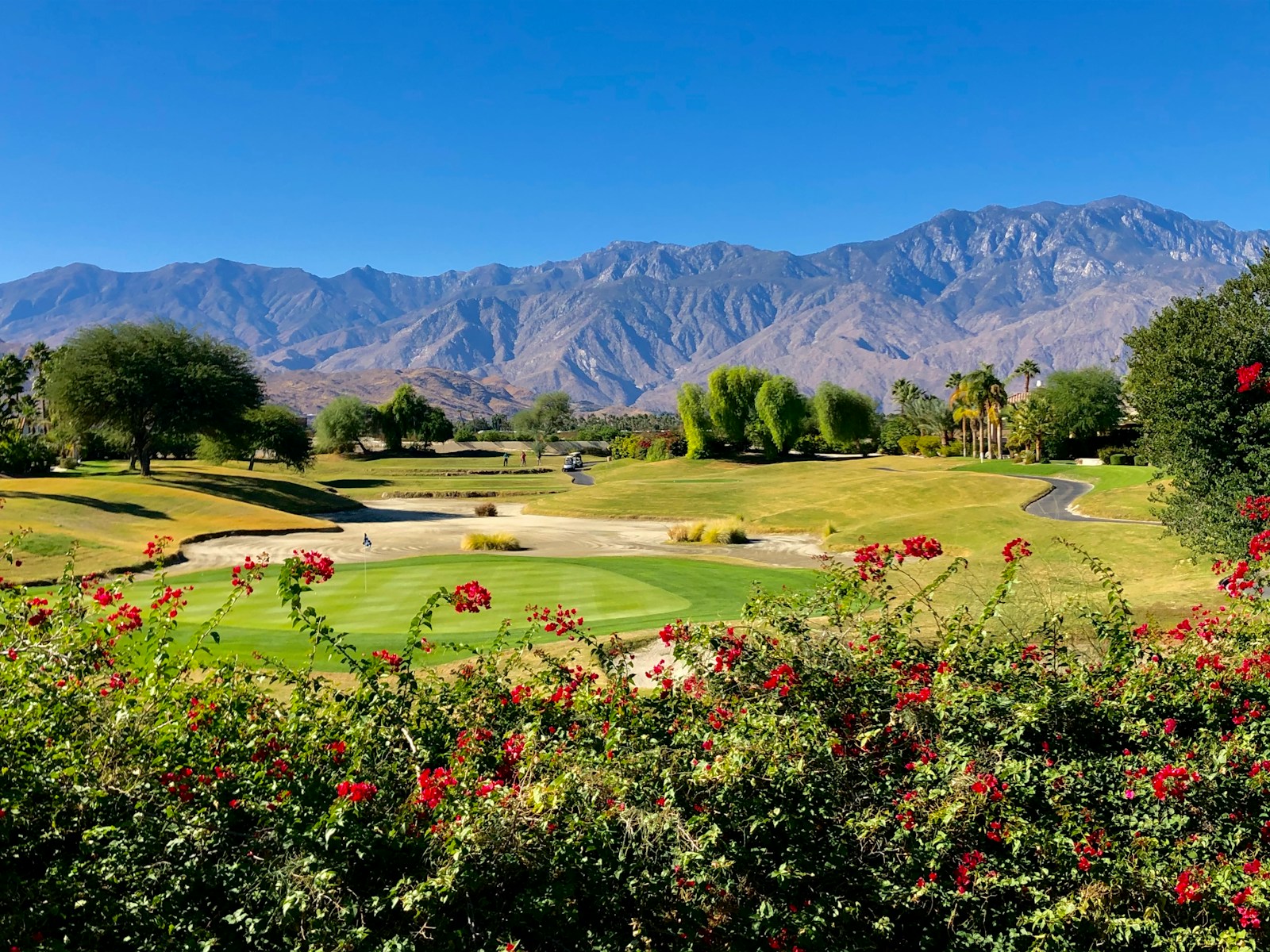
The Hideaway is a 36-hole private community on Hideaway Way in central La Quinta. Its defining feature is the rare pairing of two complete 18-hole routings behind a single gate, one by Pete Dye and one by Clive Clark. Members move freely between the two courses, which gives the club an unusual breadth of golf for its size and lets the architectural personalities sit side-by-side in productive contrast: Dye’s visual edge against Clark’s more open, member-friendly lines. The real-estate footprint is mid-scale, the architecture is cohesive, and the membership feels notably tighter than at the larger resort-scale Coachella Valley clubs despite the comparable course count.
The two courses
The Pete Dye course at The Hideaway is the more visually intimidating of the two — bunkers cut hard against fairway lines, water in play on the closing holes, and the visual misdirection Dye built his reputation on. The Clive Clark course, completed slightly later, is widely regarded as the friendlier daily-play option: wider landing areas, more conservative green complexes, and an emphasis on playability. Members typically rotate, but most settle into a personal preference quickly. The conditioning standard across both courses is consistent year-round.
Membership & access
The Hideaway is equity, with a defined cap that keeps tee-sheet pressure manageable across 36 holes. Like Madison Club it is not a resort or daily-fee operation, and outside play is limited. Initiation and dues figures are not published here — verify directly. The membership skews seasonal, with a higher proportion of active golfers than at clubs known more for the lifestyle than the play. Family programming exists but the dominant rhythm is the morning golf round.
The real estate
Hideaway homes are predominantly custom-built single-family estates, with a smaller secondary band of fairway homes on more modest lots. The architectural language leans contemporary California with Spanish-Mediterranean accents. Lot sizes vary widely — some of the original Dye-side estate lots are substantial, while the Clark-side homes are more uniformly mid-scale. Inventory turns slowly; a typical year sees a single-digit number of resales across the community.
How membership actually works
- Structure
- Equity — full golf.
- Initiation tier
- High.
- Dues tier
- High.
- Waitlist
- Verify directly. Not a resort-facing operation.
- Transfer terms
- Not publicly published; verify with the membership office.
- Guest / outside play
- Member-and-guest with limited outside play.
Buyer fitBest for an active-golf buyer who wants breadth (two full 18s) with a tighter club feel than the larger resort-scale Coachella Valley clubs.
Membership figures move. Verify current initiation, dues, and transfer terms directly with the club before making financial commitments.
The architect and the design signature
- Primary designer
- Pete Dye (Dye Course) and Clive Clark (Clark Course).
- Era
- Dye course completed 2003; Clark course completed 2005.
- Other Coachella work
- Pete Dye also designed courses elsewhere in the Coachella Valley; Clive Clark’s desert work is more limited.
- Design signature
- Dye: strategic misdirection, hard-cut bunker edges, water in play on closers. Clark: wider corridors, more open green fronts.
- Play character
- Dye plays visually intimidating from any tee; Clark plays as a member-friendly rotation option.
Price band, inventory and product mix
- Band tier
- High — mid-scale to estate.
- Typical range
- Custom estates commonly in the mid-seven to low-eight figures. Fairway homes at more modest points.
- Lot size
- Wide variation — original Dye-side estate lots run large; Clark-side homes are more uniformly mid-scale.
- Dominant vintage
- 2003–2015 for most inventory; ongoing custom remodels.
- Dominant style
- Contemporary California with Spanish-Mediterranean accents.
- Inventory velocity
- Low — single-digit resales per year in a typical cycle.
- Entry product
- Fairway single-family homes; no condo stock.
Price bands are directional and reflect observed listings and public transaction ranges. Verify current pricing with a California-licensed real estate professional before making an offer.
What to verify when you tour
- Ask whether the lot backs onto Dye or Clark — the daily-play character is materially different.
- Verify irrigation and turf policy; conditioning cost is a real line item at 36 holes.
- Confirm access rights to both courses under the specific membership tier.
- Check remodel restrictions early — architectural code is enforced.
Estimate only — verify with a licensed California real-estate professional before transacting.
Frequently asked
- Which Hideaway course is harder?
- The Pete Dye course is widely considered the more demanding of the two. The Clive Clark course is the more member-friendly daily play.
- Can a member play both courses?
- Yes. Members rotate freely between the two routings; most settle into a personal preference within the first season.
- Is this site affiliated with the club?
- No. La Quinta Golf Lifestyle has no formal affiliation with any private club referenced on the site. We do partner with California-licensed real estate professionals who specialize in La Quinta clubs.
- Can you list a home in this community for me?
- We work with a California-licensed real-estate partner who handles current listings, private showings, and representation. Tell us what you're looking for and we'll connect you.
Buyers researching The Hideaway also search for
- The Hideaway La Quinta homes for sale
- Pete Dye Hideaway course
- Clive Clark La Quinta
- The Hideaway membership initiation
These are common search phrases used by La Quinta golf-community buyers. To dig into any of them, take the community-fit quiz, browse the buyer guides, or request an editorial valuation.